Tuesday, July 14, 2009

Monday, July 13, 2009
Musungu Sings
 I somehow tend to end up in karaoke bars in foreign countries…and Zambia did not let down. Saturday night a crew of us went to one of the 'nicer' spots in town for drinks and to my surprise - karaoke. The restaurant looked as if I clown was in charge of the decorating, and the accompanying music was just a synthesizer playing the famous tunes we would eventually sing. Nonetheless, it was an incredible night. The group desperately wanted me to sing ‘Born in the USA’, but I refused. Another option was a duet. My friend Alex and I find it far too entertaining to refer to each other as musungu (white) and mufita (black), so we thought it would also be very fitting if we sang Ebony and Ivory, but neither of us actually knew the song, so it was a failed attempt. I debated 'Sexual Healing', but finally settled on ‘I Will Survive’, followed by ‘If I Could Turn Back Time’, which the crowd really liked. (Becky – I did my best to impersonate you impersonating Cher).
 Missus Compound
Having spent a year working in Guguletu (Gugus), a township outside of Cape Town, I was very interested to visit one of the compounds in Lusaka. While the compounds are not a result of the blatant separation of people based on race, as in South Africa, they are definitely a symbol of the deeply entrenched poverty in Zambia (also very much related to race). And are a staggering contrast to the rest of the neighborhoods in Lusaka.
With only a few weeks left in the country, I finally convinced a friend, Awiya, to take me into a compound. Most people are not keen on bringing musungus into these settlements, but when he realized I was going with our without him, he decided it was best to accompany me.
Misisi (pronounced missus) Compound is the oldest in Lusaka and used to be a place where the British folk resided during colonial times. One older white woman continued to live there, even after the rest of her kinfolk flocked back home or to different neighborhoods. Everyone referred to her as ‘Missus’… and the name stuck. Oh the legacy of colonial times…(David) Livingstone, Zambia….Victoria Falls…and now Missus Compound.
There is one long, dusty road that stretches through the entire compound. We followed the road from start to finish….which is enormous. I was overwhelmed. I had seen plenty of poverty and desperation in the rural villages, but this was so different and I can’t even pinpoint exactly why. So many people come back from visits to poor areas throughout Africa, saying “they are poor, but they are so happy”. This irritates me a bit, as I feel that it is a way to shake off responsibility to take action…but I can also see their point at times…especially in many places I have visited in the last two months. I didn’t see much happiness here…I just saw children playing in piles of disgusting trash, women engaged in exhausting manual labor, and men drinking shake-shake – the local brew. Community water pumps and toilets were sporadically placed and after an hour of walking, I only saw one school. I asked if children go to town for school and my friend said it was too expensive – most children in the compounds don’t go to school beyond the primary years.
Awiya asked if we had areas like this in the US and I tried to explain the so-called projects and other disenfranchised communities. I also explained the welfare system and our government’s attempts to mitigate the problems. He mentioned that the Zambian government didn’t care about the people in the compounds… ‘And they know that no one cares about them’, he said. ‘Why do you think there are so many churches…the only hope that people have is that God cares about them’. It was true, we had passed by a church on every block….which was usually directly across the street from a shebeen (bar). I thought about if I was living in the compounds….would I have faith in God or faith in the shake-shake to save me? I bought a carton of the shake-shake on the way out.
I don't think you're pretty....
As I walked to the market on Saturday with Alan, he explained to me how he had finally saved enough money to put a tombstone on his father’s grave, and was going to do so that afternoon. It had been a year since his father died and several years since his mother passed. At age 32 he was an orphan. He talked about how he was in college when his father died, but had to drop out to take on the responsibilities of raising his younger siblings. His story, though very sad, was not unique.
A woman approached as we neared the tracks, the part of town where the poverty becomes much more visible. She stopped Alan and began talking to him in Nyanja. He sincerely listened to her story and then retrieved 5,000 kwacha ($1) from his pocket and gave the money to the woman, no questions asked. Now Alan works as a cleaner at the lodge where I stay – which means he has a job, which is better than many Zambians, but he is by no means making a lot of money. And whatever money he does make is used to support many people, as he had just explained to me.
As we continued walking, I asked him if he was worried that he was being scammed. Two months in Zambia (and five years in San Francisco), I was growing cynical. He told me the woman’s story and said there was no reason not to believe her. (I can think of a few, I thought to myself). I then asked him how he distinguishes if the truth is being told in other situations…I had yet to master this art and was constantly leery of being manipulated. He replied that it was not up to him to question the integrity of others. But is up to him to help those in need…the burden of being more fortunate. (Fortunate? An orphan who had to drop out of school to raise his brothers and sisters….I thought).
We parted ways and I continued thinking about his unwavering trust and faith in the good in people. I also thought about the countless people that I said, “Sorry”, before I even heard their full story. I then thought about the man who threw the sandwich back in my face because he wanted money for alcohol and was not really hungry, as he claimed. Or the homeless woman who said, “I don’t think you’re pretty….no I don’t think you’re pretty at all” as I passed by her begging in Dolores Park. I decided that while Alan was an incredible person – I would continue to help with discretion, but perhaps ease up a bit on the cynicism.
I bless the rains down in Africa...
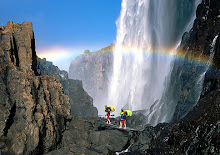
The weekend was amazing – rafting down the Zambezi during the day, jogging through the town at dusk and dancing at the disco till dawn. I needed to catch an 8:30pm bus back to Lusaka on the night of the official full moon. Fortunately, the park was open for the couple of days before and after the full moon. After a huge seafood meal with friends, we all smashed into a Land Rover and headed to the falls. We arrived about 10:15pm and had 45 minutes until closing. The sky was full of clouds, but the falls were still illuminated by the moon and the sound of the crashing water was even more intense than during the day. We walked the narrow path in the dark…there were absolutely no lights guiding the path or even another person in the park. As 11pm crept closer, I realized that the clouds had ruined my one chance at seeing the lunar rainbow. But I was so amazed by the sight of the falls at night that I didn’t even feel disappointed…
That is until the next day, in which I spent the majority debating whether or not I should attempt to go back to the park one last time before my bus left for Lusaka. The sun set just after 6:30, so this would give me over an hour in the park before I would have to rush back to town to catch the bus. About midday, I decided it was too stressful to chase the rainbow again….at about 4pm, I decided I had to at least try. I convinced Maya to return with me and we set out at 6pm, to ensure we were the first ones through the gate. I again walked the entire path, in search of the elusive rainbow. The wind had picked up, which meant we were absolutely soaking wet from the mist in less than five minutes. Other rainbow seekers stayed at the viewing point closest to the gate to avoid getting wet, but we marched on. Actually – marching is probably the wrong term, since we tripped every other step given the darkness combined with an extremely slick pathway. Safety precautions and railings are nonexistent and with each step, we were one step away from going over the edge…literally. The moon continued to rise as we made our way to the end of the path, but there was no sign of a rainbow. I entered the final viewing point, looking down to make sure I didn’t lose my footing. As I lifted my head and looked out to the bridge from Zambia to Zimbabwe, there it was… “RAINBOW”, I screamed, shocking Maya, who was still struggling with her footing.
I will never forget that first moment I spotted the rainbow...but it only became more pronounced as we made our way back to the gate. By the time we arrived at the bridge in the path, there was a full rainbow stretching from Zambia to Zimbabwe. The bridge is an incredible viewpoint, but also the wettest portion of the walk. Therefore, I would normally run across as fast as I could, head tucked down to keep the mist of my face. But this night was different. I stood in the middle of the bridge, the entire falls stretching before me, the lunar rainbow overhead and sang Toto’s ‘Africa’ at the top of my lungs with the mist streaming down my face. Now raise your hand if you you think I am one ridiculous musungu (my hand is raised).

Sunday, July 5, 2009
It's just a ball...
I have been in Zambian long enough now that I am starting to revisit the villages. I was quite excited to return to Mukubwe. I visited this site before I became overwhelmed with the challenges at the clinics… the days when I had time to give into-to-English lessons with the roomful of children and followed by hours of chase. A group of the older boys had asked if I could bring them a soccer ball (what they were using barely was deflated and torn to pieces) when I returned. I nearly forgot the promise and had to scramble around town looking for a ball to buy the night before I set off for the visit.
After several hours of retraining the staff (for a third time) on the protocols, I made my way across the field from the clinic to the school, the usual frustration and anxiety taking over my thoughts. Immediately children appeared out of the elephant grass and ran towards me. I knew they recognized me, as all children run away from musungus, not towards upon first meeting. With each hug, my earlier frustrations became less and less urgent and the anxiety dissipated.
I found the headmaster to give him the ball, as I didn’t want to make a scene. I remembered the days in Guguletu in which visitors would bring gifts to the after-school care program and without fail, there was never enough and I would have to deal with the disappointed children. The headmaster was very pleased with the gesture and insisted we deliver the ball to the field, where a game was already in session. Thus, the scene that I was avoiding became magnified. A train of children followed behind me to the field, as if I was playing a magical flute. The soccer game stopped as I approached and the ball was spotted in the headmaster’s hands. The coaches left the sidelines to shake my hand, and the ball was closely examined, passed, kicked and bounced, as grins spread from face to face. Then the inevitable… everyone sang a song for me. The clinic officer said on the way back, ‘you have made everyone very happy today – they will celebrate’.However, I only felt like a giant ass…. the great musungu saves the day with a $10 soccer ball. I wish I would have just left the ball on the school steps with note… I wish I had brought more…I wish I could do more.
I went to bed that night still thinking about all the events of the day, particularly all the challenges at the clinic, and woke in the morning in need of a clinic. It is hard to pinpoint who is to blame. As I look through the pictures from that day, every child had a runny nose and one coach even picked his nose before extending it to shake my hand (yup a folk, that is right— I still shook his hand). Nonetheless, my throat was raw, my nose was running and every bone in my body ached. No time to nurse a cold though. With each pothole on the rural road, my body screamed back at me. We traveled from 7:30am until 12:30am that day, only reaching two clinics. As I stared out the window, feeling bad for myself, I thought of the many women I have described with pregnancy-related complications, in far greater pain than me, who had to make life-saving journeys on these roads and only in a vehicle if they were lucky. Suddenly, my discomfort was not so important.


Saturday, July 4, 2009
How does an angry woman get to other side of the river?
As I have articulated over and over again in my posts, fidelity is very hard to come by in Zambia. The part that I struggle most with is how women accept it as a fact of life. But not all women…
The village that I visited on Thursday can only be reached by a pontoon boat, crossing a river full of crocodiles. I was told a village man kept a wife on one side of the river and a girlfriend on the other side, where he went to fish. The wife caught wind of the girlfriend and set off with her sisters early in the morning to take the pontoon across the river and confront her husband. However, that same day, the husband and his girlfriend were on the other side of the river, hoping to catch the pontoon and sell the fish in the village. In a panicked state, the man jumped in a canoe and tried to quickly paddle around the pontoon to escape his angry wife. But his paddling was no match for the wife, who plunged into the water and swam (or some version of swimming that was apparently more effective than it looks) to the canoe. After throwing all of the fish back into the water, I was told she began to beat him, while everyone watched in shock from the pontoon. I would have asked for her autograph.